


Greek Philosophers
Streaming coming soon
Questions? administration@junginla.org
Twelve lectures (1993) on the early Greek philosophers, from Thales to Plotinus, as expressions of archetypal ideas that still shape the Western psyche. Each philosopher’s central image (water, number, fire, the One, the Forms, the Logos) is linked to Jungian psychology. Published as The Psyche in Antiquity, Book One (1999).
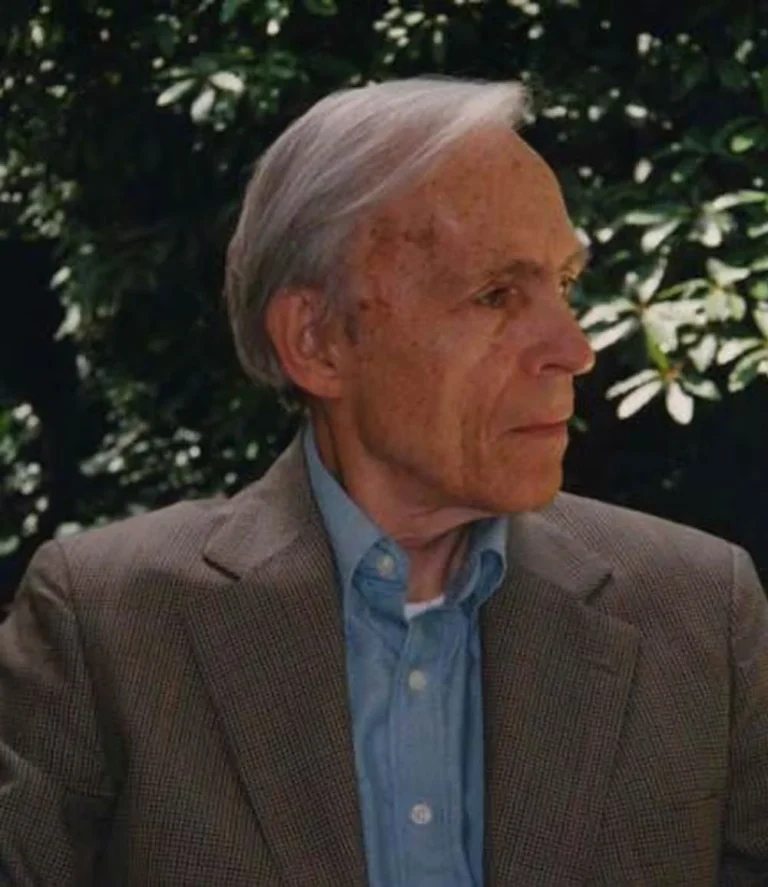
Edward F. Edinger
Edward F. Edinger (1922–1998) was an American psychiatrist and Jungian analyst, widely regarded as one of the most important interpreters of Jung. Trained in medicine at Yale, he worked in analysis with Esther Harding and was a founding member and later president of the C.G. Jung Foundation in New York. In 1979 he moved to Los Angeles, where he was a senior analyst at the C.G. Jung Institute and gave the lecture series recorded here. His books include Ego and Archetype (1972), The Creation of Consciousness (1984), Anatomy of the Psyche (1985) and many volumes drawn from his lectures.
Parts
-
Part 1: Introduction
1:05:16
Introduces twelve weekly sessions of 75 minutes (about 45 minutes of lecture and 30 of discussion: 'don't be afraid of revealing your ignorance'). Besides the assigned texts, Edinger recommends further books for those wanting more, starting with F.E. Peters' Greek Philosophical Terms: A Historical Lexicon, which traces how the central concepts of Greek philosophy evolved over six or seven centuries.
-
Part 2: The Milesian Philosophers
1:09:08
The three Milesians: Thales (fl. 585 BC), his student Anaximander (fl. 560) and Anaximenes (fl. 546). Before taking them one by one, Edinger discusses two primordial concepts they brought to birth as a group: physis (Latin natura, 'nature'), a profound and ambiguous term whose growth he traces, and arche, the first principle.
-
Part 3: Pythagoras
1:07:44
Pythagoras (fl. 530 BC), a semi-legendary figure who left no writings, so that his own doctrines cannot be separated from those of the Pythagorean brotherhood that surrounded and succeeded him. Edinger notes the magical attributes in the tradition about him, and recommends Cornford's From Religion to Philosophy alongside Barnes.
-
Part 4: Heraclitus
1:03:34
Heraclitus, after a leftover on Pythagoras: his move from Samos to Croton in southern Italy, where the community formed, and the idea of koinonia, fellowship (from koinos, as in koine Greek). Then Heraclitus: fire, the logos, the unity of opposites and enantiodromia, a concept Jung adopted directly.
-
Part 5: Parmenides and Anaxagoras
1:08:33
Parmenides (fl. 475 BC) of Elea in southern Italy, founder of the Eleatic school and, like an archaic wise man, both philosopher and lawgiver. Edinger summarises the three parts of his surviving poem, starting with the prologue. He then takes up Anaxagoras and Nous, Mind ordering the cosmos.
-
Part 6: Empedocles
1:05:49
Empedocles (fl. 450 BC) of Acragas in Sicily, a complex and mysterious figure combining rational philosopher with shaman or magician, influenced like Pythagoras by Orphism, around whom legends gathered (including his leap into Etna to become immortal). His four roots moved by Love and Strife. Socrates, also on the programme, is held over.
-
Part 7: Socrates and Plato
1:11:54
Socrates (470–399 BC) and Plato, a 'double star', in Emerson's phrase, that no telescope can resolve. Edinger contrasts them: Plato an aristocrat and introverted thinker; Socrates a commoner, son of a stonecutter and a midwife, a talker rather than a writer, and an extravert always making personal connections with young men. His inner daimon; Plato's Forms as precursors of the archetypes.
-
Part 8: Aristotle
1:07:34
Aristotle (384–322 BC): born at Stagira in Macedonia, son of the court physician; twenty years as Plato's student; tutor of the young Alexander; founder and head of the Peripatetic school in Athens; and his difficult position after Alexander's death in 323. Then his philosophy: form and matter, potentiality and actuality, entelechy and the unmoved mover.
-
Part 9: Zeno of Citium
0:59:39
Zeno of Citium (c. 340–265 BC), not to be confused with Zeno of Elea. Born in Cyprus of Phoenician, Semitic descent, which scholars see as giving Stoicism a more religious flavour. He was the father of the school named after the Stoa, first of the trio Zeno, Cleanthes and Chrysippus, whose doctrines are so intermixed that Edinger treats Stoicism as a whole.
-
Part 10: Philo
1:09:36
Philo of Alexandria, three centuries after Zeno, by which time 'the whole nature of the psyche has changed'. Edinger acknowledges his debt to Erwin R. Goodenough's An Introduction to Philo Judaeus, and stresses that Philo was an exact contemporary of Jesus and Paul. Then Philo's allegorical reading of Scripture and his doctrine of the Logos.
-
Part 11: Plotinus
1:11:16
Plotinus (AD 204–270), the last of the fourteen figures, almost 600 years after Plato, whom he considered his master. Father of Neoplatonism, he claimed no originality but systematised Plato and brought him into relation with human experience. His work survives because his student Porphyry edited the Enneads and prefaced them with a biography. The One, Nous and the World Soul.
-
Part 12: Conclusion
1:03:45
A brief look back, then most of the time on the 'deposits' Greek philosophy has left in other streams of the collective psyche. Edinger repeats Burnet's summary from the first session: Greek philosophy is dominated from beginning to end by the problem of reality, 'What is real?', and of man's relation to it.