


The Mysterium Lectures
Streaming coming soon
Questions? administration@junginla.org
Twenty-seven classes over two semesters (12 + 15), originally given to the C.G. Jung community in Los Angeles, working through Jung’s Mysterium Coniunctionis (CW 14) paragraph by paragraph, from ¶1 to ¶792. Edinger calls it ‘the summa of Jungian psychology’ and opens each class by listing the ‘major images’ of the week’s assignment. Remastered and edited recordings. Published as The Mysterium Lectures (1995).
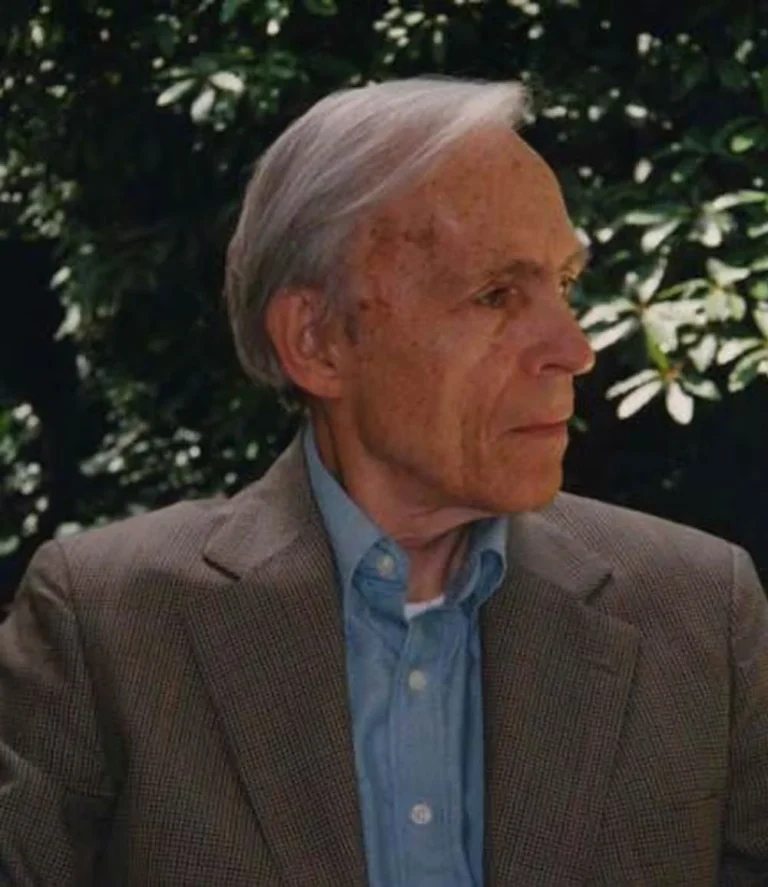
Edward F. Edinger
Edward F. Edinger (1922–1998) was an American psychiatrist and Jungian analyst, widely regarded as one of the most important interpreters of Jung. Trained in medicine at Yale, he worked in analysis with Esther Harding and was a founding member and later president of the C.G. Jung Foundation in New York. In 1979 he moved to Los Angeles, where he was a senior analyst at the C.G. Jung Institute and gave the lecture series recorded here. His books include Ego and Archetype (1972), The Creation of Consciousness (1984), Anatomy of the Psyche (1985) and many volumes drawn from his lectures.
Parts
-
Part 1: Introduction; The Opposites and the Quaternio
1:15:45
Edinger introduces the course and Mysterium Coniunctionis as 'the summa of Jungian psychology', an oceanic book that will plunge everyone into confusion. He urges attention to Jung's Greek and Latin terms for their unconscious resonance. The recap in class 2 lists the images covered: the opposites in pairs and quaternities, the solar table, the crown and others.
-
Part 2: The Orphan, the Widow and the Moon
1:07:04
Covers seven images: the orphan; the widow, extended to the old woman, Isis and Medea; death in the coniunctio; Malchuth and Tifereth on the Kabbalistic Sefirotic tree; Luna as the gateway between the earthly and heavenly worlds; wounding; and kenosis, the self-emptying of God.
-
Part 3: Alchemy and Manichaeism; The Paradoxa and the Point
1:08:13
A shorter assignment with six images: Mani and the Manichaean myth; sweating and the inflammation of desire; the Manichaean wheel of light; the devil and his grandmother; the paradox, opening Jung's chapter on the paradoxa; and the point, including the jot.
-
Part 4: The Scintilla: Sparks, Eyes and the Eye of God
0:52:33
Edinger covers only u00b642u201350 and holds the rest over. Four images: the fiery sparks or scintillae shining in the darkness ('multiple luminosities'); the multiple eyes, oculi piscium; the eye of God; and the theme of undressing.
-
Part 5: The Enigma of Bologna
1:03:57
Covers the whole section on the Enigma of Bologna: the riddle; the tomb; its inscription and seven interpretations (alchemical, personalistic-reductive, spiritualistic, philosophical, erotic, ecclesiastical, psychological); the tree numen; the grave numen, with the dream of the black and white magicians and Senior's text on the serpent's semen; and the myth of Cadmus.
-
Part 6: The Personification of the Opposites: Sol
1:02:04
Opens the chapter on the personification of the opposites with the Visio Arislei, an incest fable, and the symbolism of Sol, which tends to amplify itself. Sub-themes include Sol niger (the black sun, shadow of the sun), the sun as both father and son, threefold sonship, and the sun as both ego and Self.
-
Part 7: Sulphur
0:59:33
The symbolism of sulphur as the principle of desirousness, will and compulsion, the motor factor in the psyche. Edinger treats the double sulphur, positive and negative; its four effects (it consumes, coagulates, corrupts and blackens, tinctures and matures); an alchemical active imagination on sulphur; and a dream of wounded sulphur.
-
Part 8: Luna
1:05:07
Seven features of the moon as the feminine principle: mediator and intercessor between realms; promoter of plant growth, fertility and healing; promoter of coagulatio; promoter of solutio through images of water, sap and dew; association with animals, especially cold-blooded ones and the dog; its noetic aspect, its relation to nous; and the equation of the Church with the moon.
-
Part 9: Luna: The Dog
1:00:22
Edinger covers dog symbolism in its entirety. He begins with the legend of pulling up the mandrake root and then gives five features of the dog: its tie to Hecate, hell and the underworld; the dog as pursuer; as the despised and insignificant one; as guardian; and as companion. Two alchemical texts close the class.
-
Part 10: Luna and Sal: The Poisonous Mirror; The Salt Triad
0:50:51
From the recap in class 11: Paracelsus' text on the moon as 'the great poisonous mirror of nature'; the basilisk; and the start of salt symbolism. This includes the triad of sulphur, mercury and salt becoming a quaternity; the Christian Trinity becoming a quaternity through Mary; the Assumption of the Virgin; and an interpretation of the Pandora picture handed out in class.
-
Part 11: Sal: Bitterness, the Sea and the Red Sea
0:56:45
Continues salt symbolism with six items: salt and bitterness; salt and the sea; salt and ashes, including the salt spirit; the Red Sea, leading into the symbolism of the Exodus; the serpent-chariot text; and Ezekiel's vision, with Jung's formula of the Self as amplification.
-
Part 12: Sal: Maier's Peregrinatio
1:03:21
The last class of the first semester, a digression from salt through the Red Sea: the whole assignment interprets Michael Maier's Peregrinatio, the adept's journey through the four continents (horizontal) and then the seven planets (vertical). Edinger condenses the text, scattered across Jung's pages, and also discusses the Shepherd of Hermas and the Emerald Tablet of Hermes.
-
Part 13: Sal: Conclusion
0:54:07
First class of the second semester and last of four on salt, reviewing the triad and the Mary analogy. Topics: salt as aqua permanens and divine water; its purifying and preserving effects; salt as ash and the vitreous body, the glorified body, with glass symbolism; salt as the soul, anima mundi and Sapientia Dei; and salt as Eros, in its two aspects of wisdom and bitterness.
-
Part 14: Rex and Regina: The Symbolism of the King
0:49:54
A new chapter centred on the image of the king, in six features: the emergence of divine kingship in Egypt and its trinity, compared with the Christian Trinity; two psychological aspects of kingship (the first coming as ego development, and death and rebirth); ritual regicide; the King of the Wood at Nemi (Frazer); Osiris; and the allegory of Merlin, with the dropsical king and his physicians.
-
Part 15: The Regeneration of the King: Ripley's Cantilena
0:57:30
Edinger sets aside his usual list of images to work through the first half of George Ripley's Cantilena. A king who identifies himself with God, the Ancient of Days, cannot create. He must crawl back into the queen's womb (also the alchemical vessel) and dissolve into his prima materia. The queen then bears both putrefaction and gestation in sealed introversion.
-
Part 16: The Regeneration of the King: The Cantilena, continued
0:58:21
Completes Ripley's Cantilena from the queen's retreat to her sealed chamber: the golden cup of Babylon, the incubating heat that brings about the rebirth and miraculous transformation of the king, and the sequence of circle into square and square into circle.
-
Part 17: The Dark Side of the King
1:00:46
Organised around a single alchemical text quoted at u00b6465, beginning 'When heat operates upon a moist body, then is blackness the first result', which continues the king's transformation imagery. The recap in class 18 schematises four stages: fog, darkness and drowning; the first day of creation, the day of Yahweh; dawn, many colours and renewal as worm or snake; and apotheosis with crown, sceptre and seven stars.
-
Part 18: The King-Symbol and Consciousness; The Religious Problem of Renewal
1:13:25
The sections 'The Relation of the King-Symbol to Consciousness' and 'The Religious Problem of the King's Renewal' are 'an oasis of straight prose interpretation' in a densely symbolic book. Edinger goes over the four stages again and draws out their meaning on two levels: the individual, and the collective death and rebirth of the God-image.
-
Part 19: Regina; Adam and the Statue
1:00:47
The queen as the feminine royal figure leads to the question of how a man's ego and a woman's ego each relate to the masculine and feminine principles, illustrated with a chart. The new chapter on Adam and Eve then begins with Adam as arcane substance and the symbolism of the statue: Pygmalion and Galatea, and Don Giovanni.
-
Part 20: Adam as First Adept and Anthropos
1:03:19
Images: Adam as wise man and first alchemist, with his book of wisdom; Adam as the first in a series of eight prophets; the polarity and androgyny of Adam, both male and female, spirit and matter; Adam as Anthropos, with Adam Kadmon in the Kabbalah. Two Adam dreams are presented, and the reading of Abraham Eleazar's text begins.
-
Part 21: Abraham Eleazar's Text and the Song of Songs
0:56:07
A leisurely reading, as Jung himself gives it, of Abraham Eleazar's alchemical text, which draws heavily on the Song of Songs. Edinger sets it beside the other great Song of Songs text, the Aurora Consurgens edited by Marie-Louise von Franz, and reviews the Song of Songs imagery the text depends on.
-
Part 22: The Black Shulamite: Eleazar's Text, continued
0:58:36
Continues Eleazar's complex text, its two parts read as a transformation in the alchemical flask spoken by the personified prima materia, the black Shulamite: 'Noah must wash me in the deepest seau2026 my blackness'. She lies in the desert among serpents and is fixed to a black cross.
-
Part 23: End of Eleazar's Text; The Conjunction Begins
0:50:26
Completes the Eleazar text: the black Shulamite, washed by Noah and fixed to the black cross, becomes shining bright and brings forth the old Adam, who is also Adam Kadmon; disrobed and confessing Eve's sin, she passes from blackness to greenness. The final chapter then opens with the three stages of the coniunctio, the axiom of Maria and the tetractys.
-
Part 24: The Three Stages of the Coniunctio; Dorn's Recipe
1:02:52
Edinger reviews and elaborates the three stages of the coniunctio as an epitome of the whole book that every student should understand: the unio mentalis, the reunion of the unio mentalis with the body, and the unus mundus. He then works through Gerhard Dorn's recipe for the second stage, the union with the body.
-
Part 25: Dorn's Recipe; The Monocolus
0:56:47
Dorn's two-part recipe: producing the caelum, a heavenly substance hidden in the body and read as the imago Dei in the darkness of matter, then mixing it with honey, chelidonia, rosemary, mercurialis, red lily and human blood. The recap in class 26 adds Albertus Magnus' quicksilver text, the monocolus (uniped), indivisibility and decapitation symbolism and dreams.
-
Part 26: Psychological Interpretation: Active Imagination and Transference
0:58:47
Restates the three stages of the coniunctio, with the unio mentalis as a separation of soul and spirit from the body (a mortificatio) that wins a spiritual standpoint over against the world. Edinger then turns to two psychological manifestations of the coniunctio, active imagination and transference.
-
Part 27: Conclusion: Transference, Countertransference and the Unus Mundus
0:51:29
The final class, in which Jung sets out the psychological meaning of all the preceding imagery. Edinger adds remarks on countertransference as an induction phenomenon: transference and countertransference are unconscious manifestations of the coniunctio archetype, and an archetype makes problems when it acts unconsciously rather than consciously.