


The New God-Image
Streaming coming soon
Questions? administration@junginla.org
A ten-week seminar (1991) on fourteen letters Jung wrote in 1951–61 about a new God-image emerging from depth psychology, grouped as epistemological premises, the paradoxical God and continuing incarnation. Published as The New God-Image (1996).
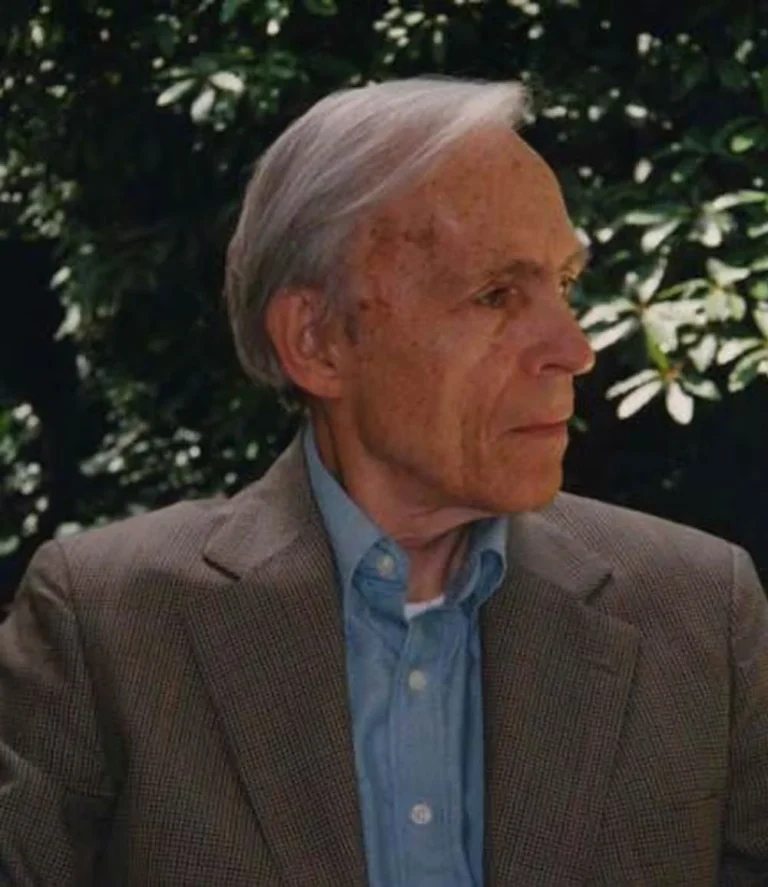
Edward F. Edinger
Edward F. Edinger (1922–1998) was an American psychiatrist and Jungian analyst, widely regarded as one of the most important interpreters of Jung. Trained in medicine at Yale, he worked in analysis with Esther Harding and was a founding member and later president of the C.G. Jung Foundation in New York. In 1979 he moved to Los Angeles, where he was a senior analyst at the C.G. Jung Institute and gave the lecture series recorded here. His books include Ego and Archetype (1972), The Creation of Consciousness (1984), Anatomy of the Psyche (1985) and many volumes drawn from his lectures.
Parts
-
Part 1: Introduction to the Course
1:10:24
Practical details: readings come from Jung's Letters, vol. 2, and, for the last two sessions, CW 18 (also in the paperback Psychology and Western Religion), with a photocopy packet of all the letters. Ten weekly sessions, skipping Thanksgiving (28 November) and ending on Wednesday 4 December, which dates the course to autumn 1991.
-
Part 2: Letter to Bernhard Lang (June 1957)
1:10:15
Edinger sets out the three themes that guided his choice of letters, understood as three steps: Jung's epistemological premises (classes 2u20135), the paradoxical God (6u20137), and continuing incarnation (7u201310). He then picks items from the letter to Lang, written in the context of the Buberu2013Jung controversy, to comment on and amplify.
-
Part 3: Kant, Schopenhauer and the Letter to Walter Bernet
1:11:55
Follows up last week's discussion of Kant as a major precursor of Jung with a chain of figures who passed on the Kantian torch. Kant showed the mind's forms and categories structure experience, so the thing-in-itself is unknowable; Schopenhauer thought he had found it, as will, in The World as Will and Representation. The letter discussed is to Walter Bernet, who had charged Answer to Job with blasphemy.
-
Part 4: Anthropomorphisms and the God-Image
1:11:20
Returns to the Bernet letter's statement that 'all statements about and beyond the ultimate are anthropomorphisms', which theologians mistake for God. Edinger explains the term and why every psychic representation must be anthropomorphic ('if horses had a conception of Godu2026'), tests it on Answer to Job u00b6605 (Yahweh as an amoral force of nature), and takes up Jung's response to Martin Buber.
-
Part 5: Letter to Pastor Tanner (12 February 1959): The Nature of Religion
1:11:00
The subject is the nature of religion, central to Jung's psychology because he holds that the psyche has a religious function. Jung clarifies what he means by 'religion' and 'religious', starting from the two ancient etymologies, religare (Augustine's 'binding back') and relegere (careful observation). The letter also answers Rudolf Bultmann.
-
Part 6: Two Letters to Victor White (1953u201354): The Paradoxical God
1:05:29
The second theme, the paradoxical God, begins. After Jung's replies to Martin Buber (Jewish) and Rudolf Bultmann (Protestant), these letters answer the third of a theological triad: Victor White, an English Dominican and Catholic theologian who was for a time Jung's friend and spent time with him, though their friendship later waned.
-
Part 7: Letters to Erich Neumann (1959) and of 28 June 1956
1:13:20
A heavy agenda, so Edinger talks for an hour rather than 45 minutes. First a leftover from the White letters: Jung's use of consolamentum, the central rite of the Cathars, for the vision of a coming aeon of the Holy Spirit (Joachim of Flora) in which the opposites tearing the world apart are reconciled. Then the two assigned letters.
-
Part 8: Letters to Elined Kotschnig (1956) and Morton Kelsey (1958): Continuing Incarnation
1:12:31
The third theme, continuing incarnation. The Kotschnig letter is 'a wonderful gem', perhaps Jung's most explicit account of the evolving God-image and the ego's relation to it: a creator who took a thousand million years and endless detours to produce consciousness behaves like a being of very limited consciousness, without foresight of an ultimate goal.
-
Part 9: Letter to Pastor Lachat (CW 18)
1:09:30
On Jung's letter to Pastor Lachat, written on receiving his book on the reception and action of the Holy Spirit in personal and community life. Edinger first proposes filling a gap at u00b61536, a Greek word never inserted when the letter was copied from Jung's files, citing a parallel at u00b6240 of the Trinity essay. The subject provoked a vigorous reaction from Jung.
-
Part 10: Two Letters to David Cox (CW 18)
1:09:20
Final session, on the two letters to the Rev. David Cox. Edinger first answers a question from the previous class: does similar material appear in Jewish imagery? Yes, as in Jung's letter to James Kirsch (Letters, vol. 2), which suggests that the Sefirotic tree of the Kabbalah contains the whole symbolism of Jewish development, parallel to the Christian idea.