


Painting A Fairytale
November 17, 2026
2:00 PM

Presented by George Bright, M.A., M.Sc., Dip. Theol.
Already registered? Check your confirmation email before registering again.
SECOND DAY, THE INCANTATIONS & THE OPENING OF THE EGG
In preparation for the upcoming lectures on the Red Book, George Bright asks that you all have a copy of the reader’s edition on hand.
Registrants will receive access to recordings of Diane Zervas’ recent Red Book Images lectures, which George will reference during the session.
1: Reading Liber Novus / The Role of Fantasy and Imagination in the Analytic Process
(Liber Secundus Chapters ix & x, Second Day, pp. 291 – 299)
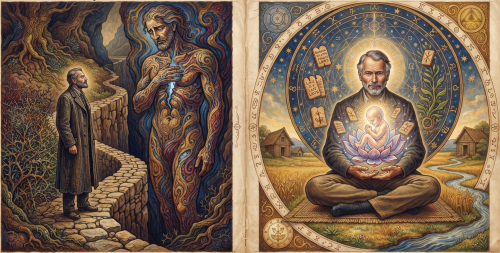
Confronted by his wounded hero, Izdubar, and unable to go forward or backward, Jung is forced to consider the situation because he cannot act. This impasse resolves when he convinces Izdubar that he is both fantasy and reality. This raises the question of how we, as clinicians, relate to fantasy, a question central to Jung’s theory and method. Jung’s account of fantasy as a psychic reality in its own right (esse in anima) was described in Psychological Types (1921, CW 6), as well as its connection to the method of active imagination, a process by which the individual utilizes imagery such as drawing and written dialogue to express and explore thoughts and emotions. Jung posited that this process helps clinicians guide patients to use their personal imagery to understand their internal world.
2: Reading Liber Novus / The Nature of the God-Image and the Role of the Self in Psychological Development
(Liber Secundus Chapters x, Incantations, pp. 299 – 306)
When, in early 1915, Jung added a second layer of text to his 1913-14 Black Book active imaginations, he inserted a whole new chapter into the Liber Novus. In his Red Book, this chapter includes 14 pages of lavish whole-page images. In this chapter, Jung meditates in prayer, incantation, and poetry on the individual’s role in giving birth to a “new God”. This ineffable process cannot be apprehended by knowledge alone but can be approached through image, poetry and incantation. This session draws on several themes explored in the incantations of giving birth to the new: the need for personal preparation, the attitude required of the individual, the nature of conversion, and the reversal of existing values. These themes are then related to Jung’s later psychological understanding of the God-image and the Self, and to processes of profound personal change encountered in psychotherapy.
3: Reading Liber Novus / The Autonomous Psyche: The Relationship of the Ego to the Collective Unconscious
(Liber Secundus Chapters x, The Opening of the Egg, pp. 299 – 306)
In this chapter, Jung realizes that his healed hero, Izdubar, is actually a solar God who ascends, showing Jung no gratitude for his role in the God’s healing and rebirth. This leads Jung into an important discussion of the individual human’s relationship with the powers he describes here as “thoughts and beings of thought which neither belong to you nor obey you.” The session compares the religious language Jung uses in this chapter with the psychological language of his published work after 1916, particularly The Relations between the Ego and the Unconscious (1928, CW 7), and considers the clinical significance of the ego’s relationship to autonomous contents of the collective unconscious.
George Bright, M.A., M.Sc., Dip. Theol., in private practice in London. Educated at Cambridge University and the London School of Economics, he serves as a Training and Supervising Analyst of the Society of Analytical Psychology and a co-founder of The Circle of Analytical Psychology, a London-based group dedicated to the study of Jung’s Liber Novus and Black Books. His 1997 paper, “Synchronicity as a Basis of Analytic Attitude,” received the Michael Fordham Prize.
Online (Zoom).
3 CE Credits Available. No partial credit will be awarded. Psychologists, LCSWs, MFTs, LPCCs: The C.G. Jung Institute of Los Angeles is approved by the American Psychological Association to sponsor continuing education for psychologists. The C.G. Jung Institute of Los Angeles maintains responsibility for this program and its content. Nurses: The C.G. Jung Institute of Los Angeles is an accredited provider approved by the California Board of Registered Nursing. Registered Nurses may claim only the actual number of hours spent in the educational activity for credit.
Requests must be emailed to publicprograms@junginla.org at least 24 hours before the program begins. No refund will be issued otherwise.
November 17, 2026
2:00 PM
November 22, 2026
10:00 AM
November 24, 2026
2:00 PM